
Nowadays, screenless fitness trackers are a big trend and everyone is talking about the newly launched Fitbit Air tracking band.
Most people are saying that Fitbit Air is an ultimate killer of Whoop, but what if I told you that there is another screenless tracker that came out nearly a year ago, does exactly the same thing, and barely anyone knows about it? Well, I am talking about Amazfit Helio.
Fitbit and Google’s Fitbit band, Fitbit Charge Six, has made a good health ecosystem, but there is another famous brand that makes budget friendly smartwatches, and they are Amazfit. From this brand, the Amazfit Helio is also a powerhouse.
Contents
Fitbit Air vs Amazfit Helio Comparison
I personally feel both of these are very identical as they come with the same price. Even the design is very similar. Both are screenless and even their battery life is huge, but when you start using them in daily life, you will see pretty clear differences.
1. Hardware and Design
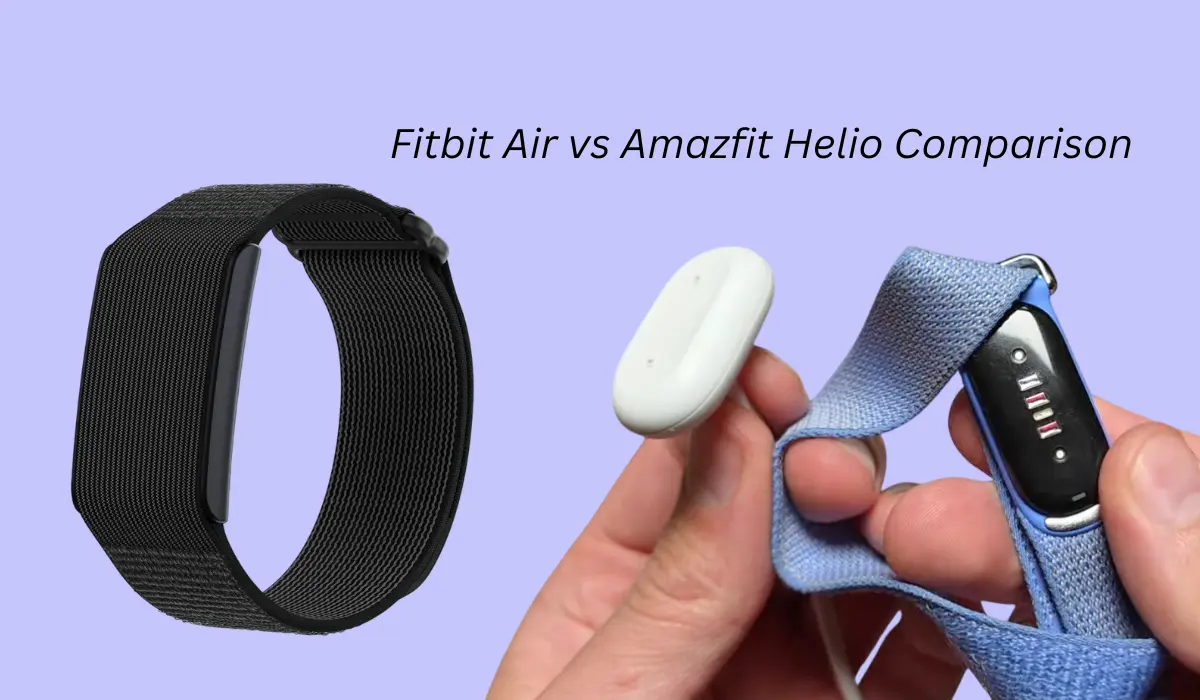
As I said earlier, the devices come with a very similar design concept, although the tracking plug snaps securely into fabric performance and both offer a secure fit, but the design philosophies are very different.
The Fitbit Air is shockingly very thin and its weight is just 12g, which is ultra minimalistic. At the same time, when we talk about Helio, it is slightly higher in weight at 20g and it is quite noticeable because it is thicker and wider than Fitbit Air.
If we talk about the strap size, then the Helio sports a 22mm strap, which is a standard size. Meanwhile, you can also use third party straps on it.
2. Charging
I find both of these devices use magnetic docks and are pretty similar, as the dock comes with a USB type connector and also has a fast charging feature. That means you can charge it within 60 or 70 minutes, which will last for around three or four days.
Even five minutes of charging can give you a whole day of battery life. With Amazfit, you will get a tiny magnetic plug which comes with the same USB type support, but you do not have to carry an extra cable. That means your phone’s USB cord will also work.
3. Battery Life
I personally have used both devices and I can say the Amazfit lasts more than nine or 10 days on a single charge, which is quite impressive. At the same time, Fitbit Air gives 6 to 7 days despite being a basic fraction less than Helio, but still the company claims seven days. So they both have phenomenal battery life.
4. Auto Workout Detection
In the Google Health app, you get voice control for auto workout and when you toggle your activities such as walking, biking, and sport activities, you will get activity data. For Helio, you have to use the Zepp app, which simply gives you a basic toggle with three sensitivity tiers: low, standard, and high.
When I personally tested Helio’s auto detection, I was completely frustrated because on standard, the routine missed around 10 minutes of my workouts, and when I bumped it to very high, it became hyper sensitive.
But at the same time, Fitbit Air was incredibly accurate. It tracked my active deviation perfectly and even auto detected my walk, treadmill, and more.
So I can say in auto workout detection, Fitbit Air is clearly better. It did not give a label to my workout explicitly but you can easily rename it after your activity.
Read this Also: Is the Fitbit Air Premium Subscription Worth It?
5. Fitness Content
I am assuming you are a fitness freak and serious about tracking your fitness. So for that matter, you will also like fitness content. In the Health app, they provide video lessons, professional instructions, mindfulness content, and even healthy food recipes.
So for me, Google Health is an absolute gold mine for health as you can filter by depression, intensity, equipment, format, and more. They have a premium workout library which you can explore.
The Zepp app for Amazfit has an explore tab where they have mentioned 50 sports modes that covers all the basic things.
However, I personally feel it lacks follow along video workouts or recipe guides, but it does sync your data to any third party apps like Strava or even Adidas Running, which is a good thing.
6. Alarm
The alarm feature is one of my favourites and I use it regularly in my daily life. In both devices, the ability to set an alarm is very easy. For that, you have to go into app settings and thankfully you can set as many as you want, so there is no restriction on setting multiple alarms in both devices.
The band vibrates silently to wake you in the morning, and you can easily disable the alarm by just double tapping on the Fitbit Air or Helio band, which will silence the vibration instantly.
7. Real World Accuracy
I compared both devices to get the actual raw metrics and after using them daily for tracking, I found both devices are phenomenal.
The numbers I received are really impressive:
Heart Rate
For heart rate tracking, both devices showed similar data during the treadmill session. It tracked for 40 minutes and the data was quite practical and identical.
The Amazfit Helio logged an average heart rate of 105 bpm while the Fitbit Air measured 109 bpm. Both workout step counts were almost matching. In the Zepp app for Amazfit Helio, it was showing 4068 steps and 4073 steps on Fitbit Air.
When it comes to overall core differences, both the Zepp app and Google Health app provide things like pace, cadence, and strike frequency but limit the initial summary to basic metrics and heart rate zones. So if you want more information, you can ask the AI coach to extract those deeper stats for you.
In my Google Health app, it registered my heart rate as 72 bpm while in the Zepp app it was showing 63 bpm, which is quite a discrepancy. To verify the actual truth, I checked my Galaxy Watch and the Amazfit reading was much closer as it was around the 63 bpm mark.
Sleep Tracking
Sleep tracking data was incredibly close. Overall, the sleep scores were very similar. I recorded my sleep durations and REM sleep. The calculations were just seven minutes apart.
In my Google Health app, it reported one hour and 19 minutes of deep sleep while in the Zepp app it recorded 42 minutes. When I checked on my Galaxy Watch, it recorded 57 minutes of deep sleep, which puts it right in the middle. Technically both are a bit closer and Zepp has the more conservative numbers.
Read this Also: Does Fitbit Air Track Sleep?
8. Subscription Cost
Now the most important thing: subscription cost. The Fitbit Premium costs one hundred dollars a year or you can take a $10 a month plan. This also unlocks the entire workout library, holistic wellness trends, and a few other features such as an AI health coach.
Through this subscription in the app, you can analyze your workout calorie burn and it also provides a breakdown of summaries. You can ask your health questions to an AI chatbot.
The Zepp app keeps 100 percent of fitness tracking features, including heart rate monitoring and workout features, completely free. Now, on the paid side, there is an Oura tab that costs $70 a year, which is quite cheaper than the Fitbit Premium subscription.
It is strictly focused on advanced sleep insights, relaxation, and also provides some premium meditative tracks and sleep sounds. You can also get advanced health risk assessments for sleep such as insomnia, apnea, and restless leg syndrome.
Conclusion
Overall, I find both screenless trackers are exceptional and highly accurate devices. As per the price, the Amazfit Helio offers a subscription free fitness app with a 22mm strap.
At the same time, Google’s Fitbit Air comes with three months of free premium subscription and a screenless tracker.
If you want an ultra comfortable watch to calculate your sleep, then Google’s Fitbit Air combines everything perfectly as it is comfortable to wear and has flawless automatic detection.